
Understanding Your Treatment
-
What to Expect During Your rehabilitation Session
Comprehensive clinical assessment — a detailed evaluation of injury pathology, postural alignment, neuromuscular control, and movement biomechanics. Individually tailored intervention planning — treatment protocols are customised based on tissue healing stage, load tolerance, and functional demands. Identification of functional deficits — precise analysis of strength asymmetries, mobility restrictions, and motor‑control impairments. Progressive correction of weaknesses — targeted exercise prescription designed to address deficits and restore optimal kinetic‑chain efficiency. Application of evidence‑based techniques — utilisation of manual therapy, neuromuscular re‑education, and load‑progression strategies aligned with current clinical guidelines. Ongoing monitoring and progression — continuous reassessment to refine interventions and ensure measurable improvements in function and performance.
-
Who This Treatment Is For
Individuals recovering from injury — ideal for those managing acute or chronic musculoskeletal conditions requiring structured, evidence‑based rehabilitation. Clients with postural dysfunction — suitable for people experiencing pain or movement limitations linked to alignment or biomechanical imbalances. Those with strength or stability deficits — effective for addressing kinetic‑chain weaknesses that impact performance or daily function. Patients needing movement re‑education — beneficial for restoring neuromuscular control and improving faulty movement patterns. Individuals seeking long‑term functional improvement — designed for anyone aiming to enhance resilience, mobility, and overall physical capability. Athletes returning to sport — supports safe, progressive return‑to‑play through targeted load management and performance‑specific conditioning.
-
What We Use in Treatment
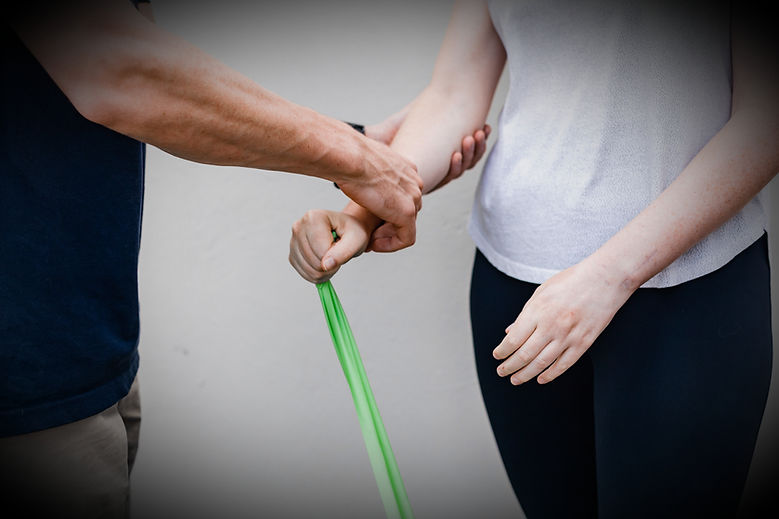
Resistance bands — gentle, adaptable bands that help strengthen key muscles without overloading your body. Light to moderate weights — controlled weight options used safely to build strength and support recovery. Medicine balls — great for improving power, coordination, and functional movement patterns. Yoga balls — supportive tools that help with balance, posture, and core activation. Core‑focused training — targeted exercises designed to improve stability, control, and overall movement quality. Tissue‑specific techniques — methods chosen to address the exact tissues involved, whether muscle, fascia, or joint structures.
-
Benefits
Improved strength — targeted exercises help rebuild muscle strength safely and progressively. Better posture — correcting alignment reduces strain and supports healthier movement. Enhanced mobility — gentle, guided techniques restore comfortable range of motion. Reduced pain and tension — strengthening and tissue‑specific work ease discomfort and prevent flare‑ups. Greater core stability — focused core training improves balance, control, and overall body support. Better movement patterns — retraining how your body moves helps prevent re‑injury and improves daily function. Increased confidence in your body — as strength and mobility improve, so does your trust in your physical abilities. Long‑term resilience — building strength and correcting weaknesses supports lasting recovery and performance.